The stuff that doesn't fit into my main blog Random Radio Jottings


Saturday, September 19, 2026

Carry On Up the Loire


She was the diminutive scene-stealing actress forever remembered as a fluttery and slightly dotty type in many British film comedies. With 30 years of stage and film experience she is surely best remembered for a handful of Carry On films. She plays Miss Cooling who helps to organise the various misfits that work for the Helping Hand Agency in Carry on Regardless. She is the tipsy table tennis-playing guest on the cruise ship SS Happy Wanderer in Carry on Cruising. And, perhaps best of all, Flo Sims who helps Hattie Jacques to organise the girls to run Glam Cabs in Carry on Cabby. On television millions laughed at her pure slapstick moments as Little Lil in The Rag Trade. Then in late 1963 she packed it all in, quietly retiring from show business and a couple of years later moving to France. She was, as far as the British general public were concerned, never heard from again. Her name was, of course, Esma Cannon.


Just ten kilometres north east of Chinon lies the village of Saint-Benoît-la-Forêt. Nestled in the Veude river valley the main village is dominated by the white tuffeau stone of the church and, in its shadow, is the Mairie. It is to Saint-Benoît-la-Forêt that Esma Cannon and her husband Ernst Littmann moved to escape the frenetic world of sixties London. They rented a house outside the main village up on the hillside in a farming hamlet called Le Châtelier. The locals knew nothing of her fame back in the UK. One girl who visited her grandparents in Le Châtelier, neighbours of the Littmanns remembered her as “a little good woman, bubbly, laughing, who seemed to have no history and who lived in harmony with her husband.”

Most film-goers probably had little idea that Esma was in fact born in Australia. Together with her mother Grace she’d moved to England around 1930. She started to work in the theatre soon after, both acting and as stage manager. By 1936 she’d obtained her first film role (most of her early roles were uncredited), made an appearances on radio in 1937 and television the year after that. She met her German-born husband when he was in the Pioneer Corps playing in an orchestra in Salisbury in his spare time. She was touring in a play in the town. They married in 1945 and a year later their son Michael was born. Ernst would go on to run a plastics factory. Esma was a real home bird who made her own clothes – she struggled to find clothes to fit her 4’9” frame- liked gardening and searching antique shops. By 1958 they’d bought a house in Priory Road, Kilburn and they kept this house on when they moved to France, with Michael continuing to live in it. I’ve found no clues as to why they ended up in France. Did they holiday there? And is it mere coincidence that in 1961 she’d appeared in an episode of Maigret in the role of Mademoiselle Doncoeur?

Esma with some of her French neighbours
(from La Nouvelle Republique)

Sadly the French dream came to an end on 18 October 1972 when Esma died, aged 66. She would be laid to rest in the local cemetery. Many friends and family apparently didn’t hear of her passing until the following year by which time Ernst had moved back to their London house. There was no wider public acknowledgment of her death until a Films and Filming ‘Where are they now?’ article appeared some years later (exact publication date unknown). Her gravestone bears just four words: Esma Littmann Nee Cannon.           

(from cartes.gouv.fr)

Over the years we must have driven up the long straight stretch of the D751 between Chinon and Azay-le Rideau two or three dozen times but we’d never turned off to drive through Saint-Benoît-la-Forêt. We’ve visited both towns since moving to France and on Loire holidays before that. Surrounded by vineyards (I can recommend a couple of good producers we’ve bought from) Chinon is dominated by the hillside chateau that overlooks the town and the Vienne river. Azay-le Rideau is famed for its beautiful chateau that appears to float on the Indre river. After reading Graham McCann’s article about Esma Cannon just a few weeks ago I decided to make the deviation off the main road.

The centre of Saint-Benoît-la-Forêt extremely well-kept. Beside the church is a car park with a grassed area, picnic benches and public toilets. On the day we visited Parc de la Pommardière there was a walking group in progress and some cyclists getting ready to set off up the hill out of the village. 150 metres past the church is the track to the village cemetery. Could we find Esma’s grave? Until about a decade ago the grave was neglected and a note beside it read ‘Anyone who may have information about this abandoned plot is asked to contact the Mairie’. Fortunately a local resident decided to research the name and discovered who it belonged to and eventually the mayor was persuaded not to destroy it.  


The cemetery is dominated by the chapel for the Chatenet de Puységur family and we started our search on the right-hand side. Drawing a blank we continued on the left-hand side and after negotiating some closely packed plots finally, there against the back wall, was Esma’s resting place. First pulling out one of two weeds I took these photographs.  


As for husband Ernst, he lived for another ten years or so, dying in September 1983. Michael, who by now had emigrated to Australia, made the journey to Saint-Benoît-la-Forêt to place his father’s ashes on Esma’s grave.  

Esma Cannon 1905-1972  

Further reading:

Graham McCann on The little Cannon that could for the British Comedy Guide

Rita Webb site with a very detailed review of Esma's career by Aaron Smith

The Carry on Blogging website

Wednesday, October 5, 2016

90 Years on the Road

Turn the clock back forty years and the chances are I would have been going into school today - South Hunsley in Melton in case you're interested - on an East Yorkshire Motor Services Bristol VR bus. Yes I was something of a bus spotter in my early teens, noting down the bus numbers, collecting tickets and timetables, attending the Sandtoft Gathering, hanging around the back of Hull bus station. (Sounds a bit dodgy that, I can assure you it wasn't).

The route from Brough to Melton was serviced by buses from the Elloughton depot so that originally meant, and I'm talking about 1973 here, AEC Bridgemasters and AEC Renowns with the occasional Daimler Fleetline or Leyland Atlantean. EYMS started to buy the Bristol VRs in 73 (they bought 150 in all) so eventually most journeys were on them. By the end of the decade I'd moved on from buses to pop music and the radio so most of the annuals, timetables and fleet lists languished in boxes until I had a clear out just before moving over to France - either sold on eBay or, chucked in the recycling.

But not everything was ditched and I've uploaded some scans on this post. The reason? On this date in 1926 East Yorkshire Motor Services Limited was registered as a company by the British Automobile Traction Co Ltd combining the services of Lee & Beaulah - who'd originally started by running services between Hull and Elloughton - and Hull & District Motor Services Ltd. So today is EYMS's 90th anniversary.

Firstly a history of the company from around the time of its fiftieth anniversary. The article by Stephen R. Smith comes from the January 1977 edition of Buses magazine - my only surviving copy.


I had a couple of boxes filled with timetable books from various companies around the UK. Goodness knows when they stopped producing these as all the timetables are online now. My copy from May 1974 cost just 8 pence.


In the 70s the EYMS livery changed. Initially, following nationalisation, they'd adopted blue and white but were forced to repaint them poppy red and white from 1974. These black and white photos come from the 'Private and Municipal Preservation Group' on Hull Road, Hessle. The AEC Renown, fleet number 757 is in the pre-nationalisation indigo and primrose livery. The Leyland Panther no 805 shows the National Bus Company logo.


I meant to sell the dozens of tickets and a few ticket rolls I had but still haven't got round to it. These will have been issued one the Setright machines in use at the time. 


Thursday, March 31, 2016

Back in Boothferry

Look for a place called 'Boothferry' on the map of England and you'd struggle. But just head north of the town of Goole and by the River Ouse there's Booth Farm in what was an old settlement called Booth - the name deriving from the Viking for summer pasture - and on the other bank Ferry Lane. This, as you'll guess, marks the site of an old ferry crossing, still in use until replaced by the swing-span bridge in July 1929.

The name Boothferry briefly appeared on the political map between 1974 and 1996 when it was adopted as the name of the district council at the western end of the Humber and centred on the port of Goole. I had the pleasure of working for the Boothferry Borough Council from 1984 until its demise twelve years later, the result of a local government shake-up to rid the area of the much-maligned Humberside County Council.

Over on my Random Radio Jottings blog you can listen to a Radio 4 programme about Goole.

The borough of Boothferry was created from bits of Yorkshire and Lincolnshire in 1974, an unhappy marriage from the start. The Wesleyean town of Epworth down in 'the Isle' felt a world away from the market and minster town of Howden.


When I joined the Council they still had offices scattered across Goole - the HQ in Stanhope Street, Housing in Carlisle Street, Planning at 149 Boothferry Road as well as the deport, market and the Baths Hall - plus a bit more of Planning in Howden and then The Gables in Epworth. Plus there were the two leisure centres and the Golf Club at Spaldington. Actually not bad for a small Council. By about 1990/1 most of the office functions were accommodated at the extended Church Street complex, complete with that specially woven carpet incorporating the BBC logo, how the locals loved that!

By 1994 the writing was on the cards for Humberside but the Local Government Commission couldn't decide what to do with Boothferry. Was it a merger with Selby or with Doncaster? Should it become part of some North Yorkshire super council or be swallowed up by East Yorkshire or North Lincolnshire? At one point the Council itself held the forelorn hope of becoming a new unitary authority: "I'm Backing Boothferry" exclaimed the slogan, with a character in the shape of the council area.

At the time of these July 1995 news reports on YTV's Calendar and BBC1's Look North the link with Doncaster MBC seemed to be on the cards.


In the end Boothfery was split in two: Goole and the north went to the East Riding of Yorkshire Council - as did I as by then I was living in Beverley - and the Isle went to North Lincolnshire Council. Boothferry Borough disappeared into the mists of the Marshlands exactly 20 years ago on 31 March 1996.          

Saturday, May 9, 2015

Walk On By

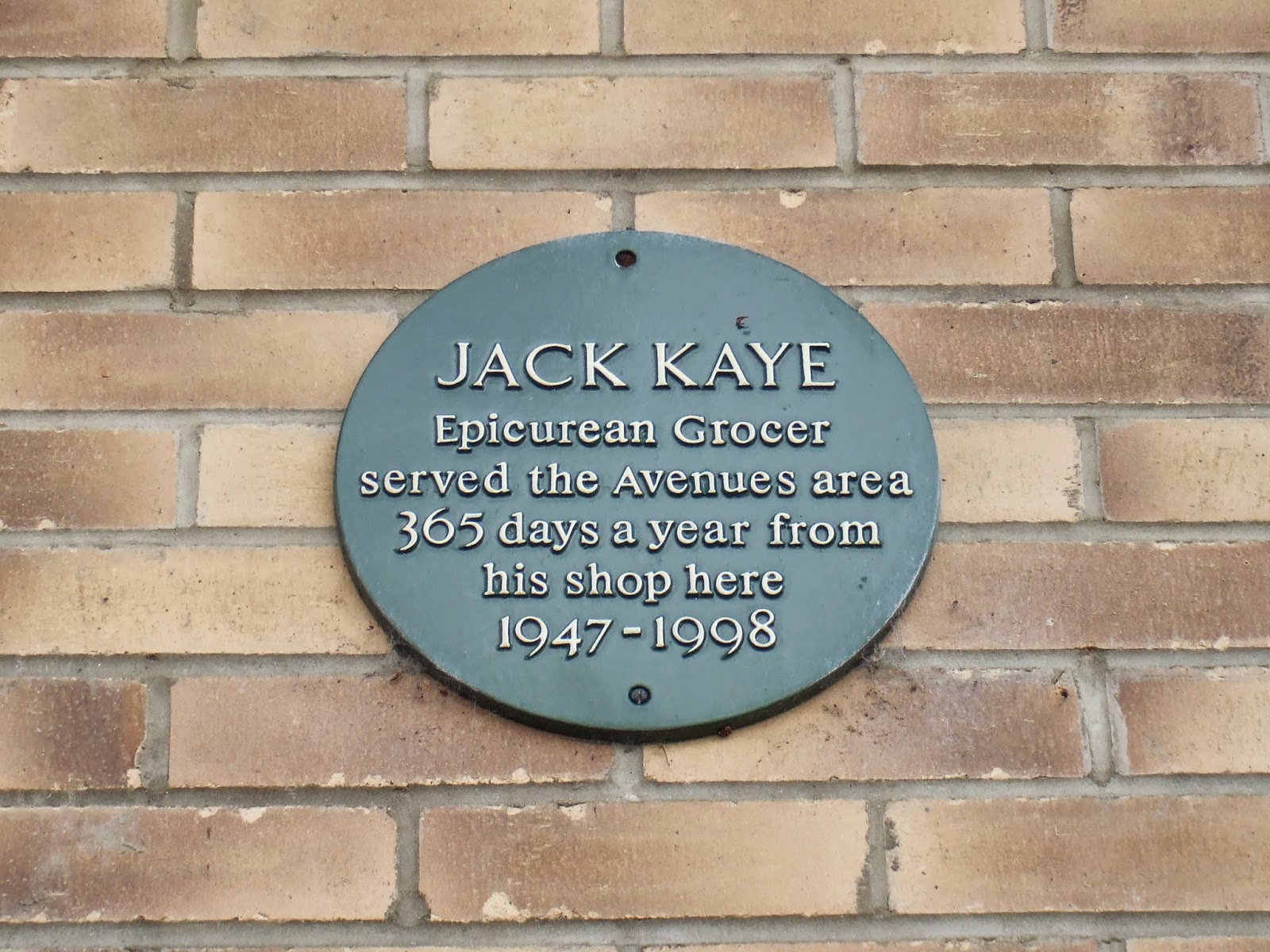
Tucked away in West Hull just off Ella Street is a path linking up with Goddard Avenue to the north. There's nothing spectacular about this cut-through that's used by pedestrians and cyclists and its name, Jack Kaye Walk, may not mean too much to those that use it. 

Look a little further and you'll discover a clue to this mysterious Jack Kaye. A plaque tells us that he was an "epicurean grocer" and that he traded in the Avenues area "for 365 days a year from his shop here 1947-1998".
Advert dating from the early 80s

As a student living on Westbourne Avenue in the early 1980s I well remember that small Mace store on the corner of Ella Street and Salisbury Street. At a time when few shops had Sunday opening it was indeed to place to pop for any last minute items you'd overlooked at Jacksons on Princes Avenue or Chanterlands Avenue. The small shop front belied the veritable Aladdin's cave of grocery products that Kaye and his team purveyed. Each customer was greeted with a cheery "good morning madam", or whatever, by the white-coated grocer. Such personal service was a rarity then, and I dare say, little in evidence in that part of Hull nowadays.
Photo of Jack Kaye from a copy of the Hull Advertiser

For any former Avenue's residents here's a rare chance to hear Jack Kaye himself when Radio 1 visited Hull on 1 April 1991. This is an extract from Gary Davies's show, billed as Gary's Easter Egg-in, accompanied by Kim Wilde.    


Jack Kaye retired in 1998 and the corner shop has now since been flattened as part of a housing development. The plaque in his memory was erected in 2012 by the Avenues and Pearson Park Residents' Association.


My thanks go to my friend Stella Flynn, and on this occasion my Hull correspondent, for taking the time to photograph the area.

Friday, April 18, 2014

Crackerjack!


There’s at least two generations who on hearing the words “Crackerjack” will instinctively shout back “Crackerjack!”  (Witness the response to Ed Stewart on Pointless Celebrities the other week.) And that Crackerjack pencil must surely be one of the most iconic pieces of stationery alongside the Blankety Blank cheque book and pen.

BBC TV’s Crackerjack ran from 1955 to 1984 and is recalled in this Radio 4 programme from the series Trumpton Riots Again titled It’s Friday, It’s Five O’Clock and It’s …

The title comes from the opening announcement to the show during its late 60s/1970s heyday and has led to the popular misconception that Crackerjack was always on a Friday and always aired at 4.55 p.m.  In fact for the first ten years under Eamonn Andrews stewardship it ran on either Wednesday or Thursdays and only moved to Fridays when Leslie Crowther took over in 1964. It was 16 December 1966 before we first get to both that well known day and time.  By the time it came to an end in 1984 it had shifted to 5.15 p.m.

This programme is presented by Jenny Hanley (of Magpie fame) and includes contributions from Michael Aspel, Ed Stewart, Don Maclean and Bernie Clifton. It was first broadcast on 26 December 1997.
 

Tuesday, April 1, 2014

Birth of a County


It was not the most popular county in England. Formed today 1 April in 1974, Humberside County Council had a lifespan of just 22 years.

This is part of the leaflet that dropped thought the letterboxes of the county just before Humberside and the new nine district councils came into existence.

My local government career started at Boothferry Borough Council in Goole but I eventually got to work at County Hall in Beverley, though by then it was as an employee of the East Riding of Yorkshire Council.

Humberside persists though, in the names of the police service, the airport and, of course, the BBC local radio station.
 

Thursday, March 6, 2014

We Cannot Return Your Paintings

Fifty years ago today saw the launch of a new children’s television series, Vision On. Though it’s nearly four decades since it ended the programme is still fondly remembered with the music, the Gallery and Pat Keysell’s reminder that “we cannot return your paintings” entering  the public consciousness.  Checking a clip online I see that Pat’s actual line was: “Thank you for sending us your pictures. Sorry that we can’t return any to you but we give a prize for all those we show.”

The Radio Times told viewers that the new fortnightly show “is intended mainly – but by no means exclusively – for deaf children. It takes the place of the old monthly programme called simply For Deaf Children, and once again Ursula Eason is the producer. Says Miss Eason: ’Nowadays, children who are deaf are encouraged to mix much more with those with hearing, and they go to the same schools whenever this is possible. So, in Vision On, we are following this trend, and we would like all children to watch it together.”

Vision On’s original presenter was Pat Keysell (Tony Hart didn’t join until January 1966). Pat was a former actress who by 1964 taught drama and mime to the hard of hearing on behalf of the RNIB.  In this Radio 4 programme from the series Trumpton Riots Again Pat, Tony, Wilf Lunn and Sylvester McCoy recall their time on the show. The presenter is Fred Harris.