The stuff that doesn't fit into my main blog Random Radio Jottings


Showing posts with label Local History. Show all posts

Thursday, March 31, 2016

Back in Boothferry

Look for a place called 'Boothferry' on the map of England and you'd struggle. But just head north of the town of Goole and by the River Ouse there's Booth Farm in what was an old settlement called Booth - the name deriving from the Viking for summer pasture - and on the other bank Ferry Lane. This, as you'll guess, marks the site of an old ferry crossing, still in use until replaced by the swing-span bridge in July 1929.

The name Boothferry briefly appeared on the political map between 1974 and 1996 when it was adopted as the name of the district council at the western end of the Humber and centred on the port of Goole. I had the pleasure of working for the Boothferry Borough Council from 1984 until its demise twelve years later, the result of a local government shake-up to rid the area of the much-maligned Humberside County Council.

Over on my Random Radio Jottings blog you can listen to a Radio 4 programme about Goole.

The borough of Boothferry was created from bits of Yorkshire and Lincolnshire in 1974, an unhappy marriage from the start. The Wesleyean town of Epworth down in 'the Isle' felt a world away from the market and minster town of Howden.


When I joined the Council they still had offices scattered across Goole - the HQ in Stanhope Street, Housing in Carlisle Street, Planning at 149 Boothferry Road as well as the deport, market and the Baths Hall - plus a bit more of Planning in Howden and then The Gables in Epworth. Plus there were the two leisure centres and the Golf Club at Spaldington. Actually not bad for a small Council. By about 1990/1 most of the office functions were accommodated at the extended Church Street complex, complete with that specially woven carpet incorporating the BBC logo, how the locals loved that!

By 1994 the writing was on the cards for Humberside but the Local Government Commission couldn't decide what to do with Boothferry. Was it a merger with Selby or with Doncaster? Should it become part of some North Yorkshire super council or be swallowed up by East Yorkshire or North Lincolnshire? At one point the Council itself held the forelorn hope of becoming a new unitary authority: "I'm Backing Boothferry" exclaimed the slogan, with a character in the shape of the council area.

At the time of these July 1995 news reports on YTV's Calendar and BBC1's Look North the link with Doncaster MBC seemed to be on the cards.


In the end Boothfery was split in two: Goole and the north went to the East Riding of Yorkshire Council - as did I as by then I was living in Beverley - and the Isle went to North Lincolnshire Council. Boothferry Borough disappeared into the mists of the Marshlands exactly 20 years ago on 31 March 1996.          

Saturday, May 9, 2015

Walk On By

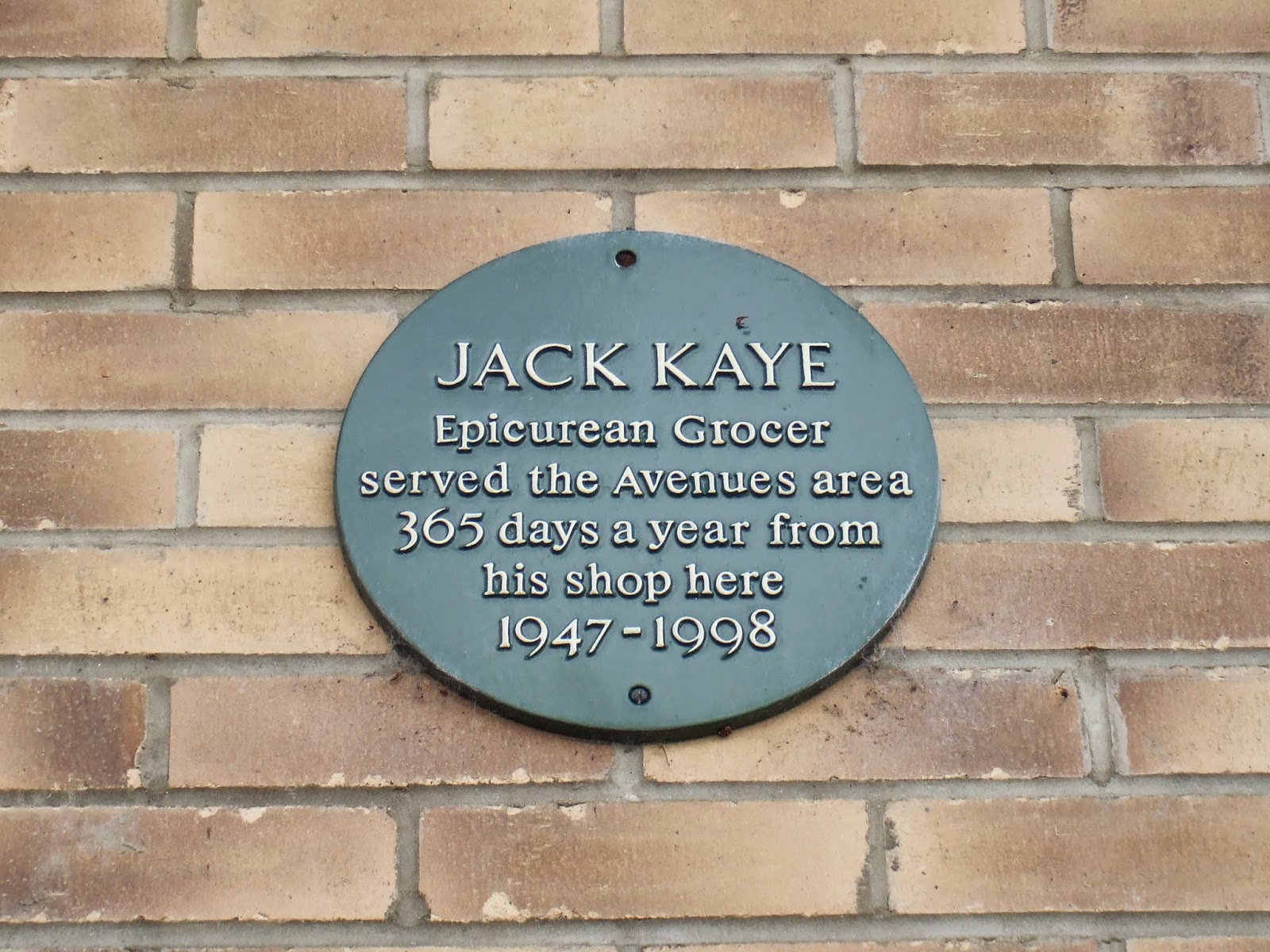
Tucked away in West Hull just off Ella Street is a path linking up with Goddard Avenue to the north. There's nothing spectacular about this cut-through that's used by pedestrians and cyclists and its name, Jack Kaye Walk, may not mean too much to those that use it. 

Look a little further and you'll discover a clue to this mysterious Jack Kaye. A plaque tells us that he was an "epicurean grocer" and that he traded in the Avenues area "for 365 days a year from his shop here 1947-1998".
Advert dating from the early 80s

As a student living on Westbourne Avenue in the early 1980s I well remember that small Mace store on the corner of Ella Street and Salisbury Street. At a time when few shops had Sunday opening it was indeed to place to pop for any last minute items you'd overlooked at Jacksons on Princes Avenue or Chanterlands Avenue. The small shop front belied the veritable Aladdin's cave of grocery products that Kaye and his team purveyed. Each customer was greeted with a cheery "good morning madam", or whatever, by the white-coated grocer. Such personal service was a rarity then, and I dare say, little in evidence in that part of Hull nowadays.
Photo of Jack Kaye from a copy of the Hull Advertiser

For any former Avenue's residents here's a rare chance to hear Jack Kaye himself when Radio 1 visited Hull on 1 April 1991. This is an extract from Gary Davies's show, billed as Gary's Easter Egg-in, accompanied by Kim Wilde.    


Jack Kaye retired in 1998 and the corner shop has now since been flattened as part of a housing development. The plaque in his memory was erected in 2012 by the Avenues and Pearson Park Residents' Association.


My thanks go to my friend Stella Flynn, and on this occasion my Hull correspondent, for taking the time to photograph the area.

Tuesday, April 1, 2014

Birth of a County


It was not the most popular county in England. Formed today 1 April in 1974, Humberside County Council had a lifespan of just 22 years.

This is part of the leaflet that dropped thought the letterboxes of the county just before Humberside and the new nine district councils came into existence.

My local government career started at Boothferry Borough Council in Goole but I eventually got to work at County Hall in Beverley, though by then it was as an employee of the East Riding of Yorkshire Council.

Humberside persists though, in the names of the police service, the airport and, of course, the BBC local radio station.
 

Sunday, July 17, 2011

The Bridge to Nowhere?

Today sees the 30th anniversary of the official opening of the Humber Bridge. The bridge’s northern towers were just a few miles away from where I was brought up at Brough. For many years the trip to see relatives in north Lincolnshire involved a train journey to Hull, a walk down to Victoria Pier and then a crossing on the Humber ferry – the Tattershall, Lincoln and Wingfield Castles.  It was either that or a long road trip via Goole – over Boothferry Bridge before the M62 Ouse crossing was built – Crowle, Scunthorpe and Barton. But from 1981 it was just a short drive over the new suspension bridge for a £1 toll.

Living locally we’d seen the towers rising up at Hessle and offshore at Barton and watched the road sections coming into what had been Priory Road sidings before being moved across to the bridge site. Those early bridge crossings by car were quite exciting for us, though they didn’t have the romance of the old paddle steamers.

Work on the bridge had started in 1973 and was planned to complete by 1977. In the event it took eight years to span the Humber and on Wednesday 24 June 1981 the Hull Daily Mail reported on opening of the bridge to the public:

Years of doubt, uncertainty and frustration faded into just a memory as Coun. Alex Clarke, chairman of the Humber Bridge Board, paid the first £1 note ever to be handed over at Hessle as a toll to the world on the other side of the murky river.

Hundreds of cheering and waving Humbersiders gathered to watch as Coun. Clarke’s Triumph estate car drove up to the barrier to start a 15 minute voyage into history as he crossed for the first official journey into south Humberside.

After an initial delay caused by a bomb scare – followed later by a delay in finding a driver for a double decker KHCT bus carrying the Bridge Board members, Coun. Clarke put his foot on the accelerator to move off at a steady 10 miles an hour on a journey of a lifetime.

The first members of the public to cross the bridge after Coun. Clarke

Here’s how that night’s News at Ten covered the story, the report starts 6:57 in.


The official opening by the Queen followed on 17 July. I can find no audio or video for that event but I do have this rather blurred photo below – taken on my old Instamatic - of the Royal train approaching Brough station. You’ll just have to take my word for it as it looks like an ordinary diesel loco from this shot.

I did once get the opportunity to go down into the North bank anchorage and round the control room so this video posted by the BBC’s Sarah Cruddas about bridge maintenance is interesting.


The toll for cars increases to £3 from 1 October.


Humber Bridge Commemorative Cover