The stuff that doesn't fit into my main blog Random Radio Jottings


Wednesday, October 5, 2016

90 Years on the Road

Turn the clock back forty years and the chances are I would have been going into school today - South Hunsley in Melton in case you're interested - on an East Yorkshire Motor Services Bristol VR bus. Yes I was something of a bus spotter in my early teens, noting down the bus numbers, collecting tickets and timetables, attending the Sandtoft Gathering, hanging around the back of Hull bus station. (Sounds a bit dodgy that, I can assure you it wasn't).

The route from Brough to Melton was serviced by buses from the Elloughton depot so that originally meant, and I'm talking about 1973 here, AEC Bridgemasters and AEC Renowns with the occasional Daimler Fleetline or Leyland Atlantean. EYMS started to buy the Bristol VRs in 73 (they bought 150 in all) so eventually most journeys were on them. By the end of the decade I'd moved on from buses to pop music and the radio so most of the annuals, timetables and fleet lists languished in boxes until I had a clear out just before moving over to France - either sold on eBay or, chucked in the recycling.

But not everything was ditched and I've uploaded some scans on this post. The reason? On this date in 1926 East Yorkshire Motor Services Limited was registered as a company by the British Automobile Traction Co Ltd combining the services of Lee & Beaulah - who'd originally started by running services between Hull and Elloughton - and Hull & District Motor Services Ltd. So today is EYMS's 90th anniversary.

Firstly a history of the company from around the time of its fiftieth anniversary. The article by Stephen R. Smith comes from the January 1977 edition of Buses magazine - my only surviving copy.


I had a couple of boxes filled with timetable books from various companies around the UK. Goodness knows when they stopped producing these as all the timetables are online now. My copy from May 1974 cost just 8 pence.


In the 70s the EYMS livery changed. Initially, following nationalisation, they'd adopted blue and white but were forced to repaint them poppy red and white from 1974. These black and white photos come from the 'Private and Municipal Preservation Group' on Hull Road, Hessle. The AEC Renown, fleet number 757 is in the pre-nationalisation indigo and primrose livery. The Leyland Panther no 805 shows the National Bus Company logo.


I meant to sell the dozens of tickets and a few ticket rolls I had but still haven't got round to it. These will have been issued one the Setright machines in use at the time. 


Thursday, March 31, 2016

Back in Boothferry

Look for a place called 'Boothferry' on the map of England and you'd struggle. But just head north of the town of Goole and by the River Ouse there's Booth Farm in what was an old settlement called Booth - the name deriving from the Viking for summer pasture - and on the other bank Ferry Lane. This, as you'll guess, marks the site of an old ferry crossing, still in use until replaced by the swing-span bridge in July 1929.

The name Boothferry briefly appeared on the political map between 1974 and 1996 when it was adopted as the name of the district council at the western end of the Humber and centred on the port of Goole. I had the pleasure of working for the Boothferry Borough Council from 1984 until its demise twelve years later, the result of a local government shake-up to rid the area of the much-maligned Humberside County Council.

Over on my Random Radio Jottings blog you can listen to a Radio 4 programme about Goole.

The borough of Boothferry was created from bits of Yorkshire and Lincolnshire in 1974, an unhappy marriage from the start. The Wesleyean town of Epworth down in 'the Isle' felt a world away from the market and minster town of Howden.


When I joined the Council they still had offices scattered across Goole - the HQ in Stanhope Street, Housing in Carlisle Street, Planning at 149 Boothferry Road as well as the deport, market and the Baths Hall - plus a bit more of Planning in Howden and then The Gables in Epworth. Plus there were the two leisure centres and the Golf Club at Spaldington. Actually not bad for a small Council. By about 1990/1 most of the office functions were accommodated at the extended Church Street complex, complete with that specially woven carpet incorporating the BBC logo, how the locals loved that!

By 1994 the writing was on the cards for Humberside but the Local Government Commission couldn't decide what to do with Boothferry. Was it a merger with Selby or with Doncaster? Should it become part of some North Yorkshire super council or be swallowed up by East Yorkshire or North Lincolnshire? At one point the Council itself held the forelorn hope of becoming a new unitary authority: "I'm Backing Boothferry" exclaimed the slogan, with a character in the shape of the council area.

At the time of these July 1995 news reports on YTV's Calendar and BBC1's Look North the link with Doncaster MBC seemed to be on the cards.


In the end Boothfery was split in two: Goole and the north went to the East Riding of Yorkshire Council - as did I as by then I was living in Beverley - and the Isle went to North Lincolnshire Council. Boothferry Borough disappeared into the mists of the Marshlands exactly 20 years ago on 31 March 1996.          

Saturday, May 9, 2015

Walk On By

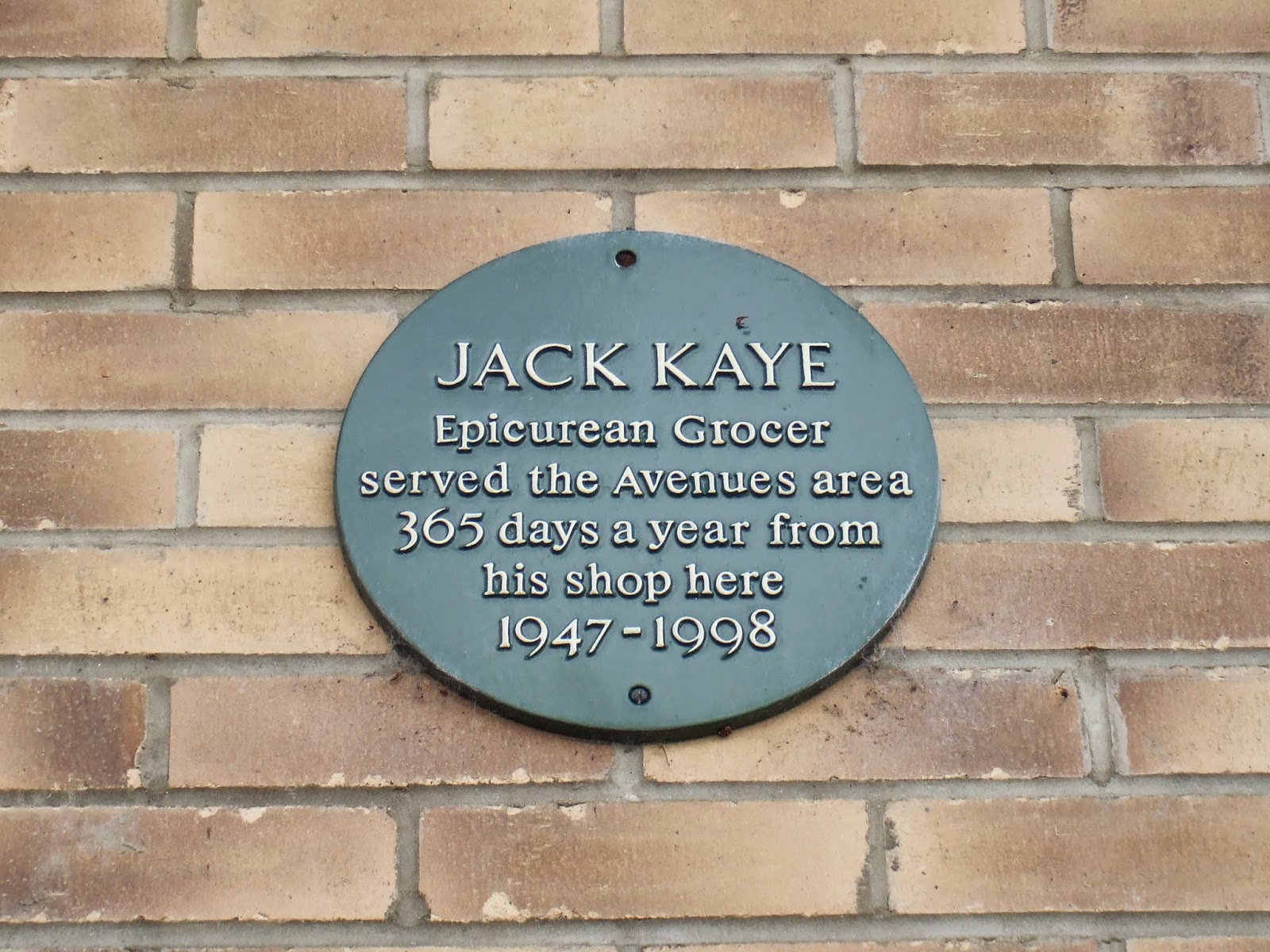
Tucked away in West Hull just off Ella Street is a path linking up with Goddard Avenue to the north. There's nothing spectacular about this cut-through that's used by pedestrians and cyclists and its name, Jack Kaye Walk, may not mean too much to those that use it. 

Look a little further and you'll discover a clue to this mysterious Jack Kaye. A plaque tells us that he was an "epicurean grocer" and that he traded in the Avenues area "for 365 days a year from his shop here 1947-1998".
Advert dating from the early 80s

As a student living on Westbourne Avenue in the early 1980s I well remember that small Mace store on the corner of Ella Street and Salisbury Street. At a time when few shops had Sunday opening it was indeed to place to pop for any last minute items you'd overlooked at Jacksons on Princes Avenue or Chanterlands Avenue. The small shop front belied the veritable Aladdin's cave of grocery products that Kaye and his team purveyed. Each customer was greeted with a cheery "good morning madam", or whatever, by the white-coated grocer. Such personal service was a rarity then, and I dare say, little in evidence in that part of Hull nowadays.
Photo of Jack Kaye from a copy of the Hull Advertiser

For any former Avenue's residents here's a rare chance to hear Jack Kaye himself when Radio 1 visited Hull on 1 April 1991. This is an extract from Gary Davies's show, billed as Gary's Easter Egg-in, accompanied by Kim Wilde.    


Jack Kaye retired in 1998 and the corner shop has now since been flattened as part of a housing development. The plaque in his memory was erected in 2012 by the Avenues and Pearson Park Residents' Association.


My thanks go to my friend Stella Flynn, and on this occasion my Hull correspondent, for taking the time to photograph the area.

Friday, April 18, 2014

Crackerjack!


There’s at least two generations who on hearing the words “Crackerjack” will instinctively shout back “Crackerjack!”  (Witness the response to Ed Stewart on Pointless Celebrities the other week.) And that Crackerjack pencil must surely be one of the most iconic pieces of stationery alongside the Blankety Blank cheque book and pen.

BBC TV’s Crackerjack ran from 1955 to 1984 and is recalled in this Radio 4 programme from the series Trumpton Riots Again titled It’s Friday, It’s Five O’Clock and It’s …

The title comes from the opening announcement to the show during its late 60s/1970s heyday and has led to the popular misconception that Crackerjack was always on a Friday and always aired at 4.55 p.m.  In fact for the first ten years under Eamonn Andrews stewardship it ran on either Wednesday or Thursdays and only moved to Fridays when Leslie Crowther took over in 1964. It was 16 December 1966 before we first get to both that well known day and time.  By the time it came to an end in 1984 it had shifted to 5.15 p.m.

This programme is presented by Jenny Hanley (of Magpie fame) and includes contributions from Michael Aspel, Ed Stewart, Don Maclean and Bernie Clifton. It was first broadcast on 26 December 1997.
 

Tuesday, April 1, 2014

Birth of a County


It was not the most popular county in England. Formed today 1 April in 1974, Humberside County Council had a lifespan of just 22 years.

This is part of the leaflet that dropped thought the letterboxes of the county just before Humberside and the new nine district councils came into existence.

My local government career started at Boothferry Borough Council in Goole but I eventually got to work at County Hall in Beverley, though by then it was as an employee of the East Riding of Yorkshire Council.

Humberside persists though, in the names of the police service, the airport and, of course, the BBC local radio station.
 

Thursday, March 6, 2014

We Cannot Return Your Paintings

Fifty years ago today saw the launch of a new children’s television series, Vision On. Though it’s nearly four decades since it ended the programme is still fondly remembered with the music, the Gallery and Pat Keysell’s reminder that “we cannot return your paintings” entering  the public consciousness.  Checking a clip online I see that Pat’s actual line was: “Thank you for sending us your pictures. Sorry that we can’t return any to you but we give a prize for all those we show.”

The Radio Times told viewers that the new fortnightly show “is intended mainly – but by no means exclusively – for deaf children. It takes the place of the old monthly programme called simply For Deaf Children, and once again Ursula Eason is the producer. Says Miss Eason: ’Nowadays, children who are deaf are encouraged to mix much more with those with hearing, and they go to the same schools whenever this is possible. So, in Vision On, we are following this trend, and we would like all children to watch it together.”

Vision On’s original presenter was Pat Keysell (Tony Hart didn’t join until January 1966). Pat was a former actress who by 1964 taught drama and mime to the hard of hearing on behalf of the RNIB.  In this Radio 4 programme from the series Trumpton Riots Again Pat, Tony, Wilf Lunn and Sylvester McCoy recall their time on the show. The presenter is Fred Harris.
 

Friday, August 9, 2013

Fursty Friday – Week 8

As a rule I tend to stay away from fruity beers. A taste of honey or hint of chocolate are OK. I was reminded of them during the recent series of The Apprentice when they had to concoct their own flavoured beer. The end results of chocolate orange (A Bitter This) and rhubarb and caramel (Rhubarb & Riches) failed to impress and Lord Sugar finally had the legitimate excuse to admonish the contestants about “piss ups” and “breweries”.   

Anyway this week’s pint is Forest Fruits, with the smell of bramble berries, and comes from the Wychwood Brewery.  And the verdict: well, remember that medicine you used to have to take as a kid....

Friday, August 2, 2013

Fursty Friday – Week 7

A few months ago when I went to visit former colleagues at City of York Council they’d not long moved into swish new office accommodation (converted railway company premises and a former station) on Station Rise.

It was a move designed to make for an improved and more efficient working environment and to save money rather than having staff scattered all over the city. I must admit I had rather a soft spot for my old basement office at St Leonard’s Place even with its limited views of passing buses and people’s feet!    

It’s mere coincidence that the new office block is just round the corner from the York Brewery on Toft Green and no coincidence at all that I’ve chosen this week’s pint as Yorkshire Terrier as yesterday was Yorkshire Day. Apparently one of the original brewers at York used to take his little terrier dog into work and tied him up to the mash tun. The dog also gives its name to the pub in Stonegate, where, on occasion in the past, I enjoyed the odd pint or two of said brew.

Friday, July 19, 2013

Fursty Friday – Week 6

It was this inquisitive little fellow that inspired the name of this series of posts. In a week where both the UK and here in France we’ve seen temperatures soar into the 30s this bottle has been put into chill for a refreshing end to the week.

Hall & Woodhouse Brewery

Friday, July 5, 2013

Fursty Friday – Week 5

It’s back to the Black Sheep Brewery for this week’s pint: Yorkshire Square Ale. Named after the brewing vessels used at Masham the bottle features a square black sheep, apparently named Paul after the brewery’s founder.

For a real ale review click on the video below.
 

Friday, June 28, 2013

Fursty Friday – Week 4

In November 2009 when the Derwent and Cocker rivers burst their banks one of the places hit was Jennings Brewery (left) in Cockermouth. The water was waist high and casks floated out of the brewery with some ending up in Workington. Production temporarily moved to Wolverhampton and Burton, but Jennings was able to re-open early the next year.

This week’s pint is Cocker Hoop, a name “derived from ‘Cock-a Hoop’, an old custom of removing the cock (or spigot) from a barrel and resting it on the hoop of the cask before commencing a drinking bout”.


Friday, June 21, 2013

Fursty Friday – Week 3

Summer’s officially here, apparently. Though you wouldn’t know it. This week here in the Poitou-Charentes we’ve had downpours, thunderstorms and hailstones heavy enough to punch holes in plastic guttering. More English weather than what we’d expect in France.

How appropriate then that this week’s pint is an English Pale Ale from Marston’s, described as "refreshing, lighter blonde ale with subtle citrus flavours and a delicate bitter aftertaste."

Friday, June 14, 2013

Fursty Friday – Week 2

Last winter was bad news for bees. Too much rain apparently. Friends of ours that have a hive sadly lost the lot.

Those clever little honey bees have their own particular dance, the waggle dance, to let their bee chums know the direction and distance to the nearest choice selection of flowers (I’m paraphrasing here!). There’s a taste of honey in this week’s beer: Waggle Dance from Wells & Young.

The weather has been dry and sunny this week apart from a heavy downpour yesterday. Fortunately the sun’s out today so I can put my feet, sip my beer and leave the hard work to the bees in the garden. 

Next week an EPA.

Your Starter for Ten

My favourite car sticker read: “Bamber Gascoigne Fixed My Starter for Ten”. The sticker was sported by my friend Peter who’d been on the Dundee team for University Challenge in 1982/3. On a couple of occasions we lent our support and made our way over the Pennines to the Granada studios. The experience proved two things: one, both on and off screen Bamber really was a nice bloke, and two, how a shabby green set can actually look quite good on the telly.

By then UC had been  a TV fixture for 20 years. The first ever edition aired at 22:45 on Friday 21 September 1962. Taking part were the Universities of Leeds and Reading. Producer Barrie Heads told the TV Times: “The questions are chosen to test quick reaction, fluency and general knowledge. The emphasis of the whole programme is on speed – and the atmosphere of the whole thing is going to be kept entertaining”

There was, however, one additional now long forgotten aspect to the game that must have been dropped fairly early on. The TV Times tells us that: “Competitors then face the additional hazard that, at any stage throughout the game, they may be asked to speak for 45 seconds on any subject. Here again (said the producer) the accent will be on wit rather than the vast intimate knowledge of the subject.”


The quiz was axed in 1987, ITV having shunted it around the schedules like unwanted leftovers,  a sure sign that it was about to be put out of its misery.  Its saviour though was a Granada theme night on BBC2 on 28 December 1992. As part of that evening’s entertainment the show was resurrected with Bamber at the helm for a pro-celebrity match. The students were from Keble College, Oxford, the last winners on the final ITV outing. The celebs were Alistair Little, John Simpson, Stephen Fry and Charles Moore.


BBC bosses obviously thought the revival of University Challenge was a damned good idea so they commissioned Granada to make a series that started in 1994. The new incarnation saw TV’s Mr Sneery, Jeremy Paxton, cajoling the students and seemingly seeing the task of explaining the rules as bothersome.  The show was a ratings winner for BBC2.  

Listen to the Archive on 4 programme on 50 Years of University Challenge
Bamber Gascoigne’s 1987 appearance on DesertIsland Discs is also available to listen again or download.

Wednesday, June 12, 2013

Goodbye Granadaland


With ITV finally decanting out of Quay Street studios into Media City there’s a rare moment of introspection from the commercial broadcaster this coming Saturday night as Peter Kay recalls the programmes emanating from Manchester in Goodbye Granadaland.


Granada Theatres Ltd was the first group to attempt to apply for a commercial television licence long before they were actually advertised, writing to the Postmaster General from 1948 onwards. The group, run by brothers Sidney and Cecil Bernstein, had the concentration of their cinemas in the south but eventually opted to bid for the northern licence. They later told the Pilkington Committee: “The North and London were the two biggest regions. Granada preferred the North because of its tradition of home-grown culture, and because it offered a chance to start a new creative industry away from the metropolitan atmosphere of London”.    

Initially Granada TV was a coast-to-coast broadcaster covering both sides of the Pennines from the Winter Hill and Emley Moor transmitters – though the latter only came on stream some six months after the launch.

Work had begun on their Quay Street headquarters in August 1955. The designer was Ralph Tubbs who’d built the Dome of Discovery at the Festival of Britain. It was to be Britain’s first purpose-built television studio complex; all the previous ones had been conversions.

On the station’s opening night on 3 May 1956 amongst the delights of Arthur Askey and (an inebriated) Quentin Reynolds was a Tribute to the BBC introduced by former BBC-man Aidan Crawley. Whilst acknowledging the debt it had made to broadcasting it effectively threw down the gauntlet to the Corporation.

Some 36 years later BBC TV celebrated the work of Granada in a theme night on BBC2.
 
Part of evening’s viewing included this documentary From the North with contributions from such Granada luminaries as Denis Forman, Jeremy Isaacs, Gus MacDonald, Tim Hewat, Silvio Narizzano, Leslie Woodhead, Derek Granger and Michael Apted.

 
From the North was broadcast on 28 December 1992.

Goodbye Granadaland goes out at 20.30 on Saturday 15 June 2013 on ITV1

Source:
Granada: The First 25 Years (BFI Dossier 1981)

Friday, June 7, 2013

Fursty Friday - Week 1


When I’m asked “what do you miss about Britain”, my response will inevitably include “a pint of beer”. Yes I know I’m in France and supposedly surrounded by vineyards (in fact the nearest are about 30 minutes away) but you can’t beat British beer.

Before we emigrated our regular Friday night after-work tradition was to pop to our local, the Warton Arms in Woodmansey, for a drink. Here in France we try to continue that tradition. Weather permitting, during the summer months, this libation takes place under the pear tree. My Friday night tipple of choice is often a glass of red wine but now and again I open up one of the bottles of bitter purchased on trips back to the UK.

Well summer’s finally here, it touched 30 degrees today, and each Friday I’ll be posting my “Furtsy Friday” pint.  Today it’s the always reliable Black Sheep - "crisp, dry and bittersweet". The glass was bought at the Black Sheep brewery in Masham. If you ever visit it why not pop into the cafe and try a slice of fruit cake, some Wensleydale cheese and a pint of Black Sheep. You can’t beat it.

Santé!   

Sunday, April 29, 2012

A Bit of a French Brew

Moving to France I think many friends thought we’d be surrounded by vineyards. That’s not exactly the case. When we look across the lane to the side of the house all we see are sheep. We’d need to travel about an hour to the nearest wine regions of the Loire or the Haute Vienne.

With all this viticulture is easy to forget that the French have a thriving brewing industry too. Admittedly you’d be hard pressed to find, at least in this part of France, the real ale and micro-breweries now so popular back in the UK, but yesterday I spent a rainy April afternoon learning about the process and, more importantly, tasting the local brew.

Based in a former diary in the picturesque village of Coulon here in the Deux-Sèvres department is the Brasserie du Marais Poitevin. Using locally sourced wild hops and organically grown grain the brasserie supplies a range of beers to suit to most discerning palate: wheat beers, lagers and what we English would recognise as a good old bitter (la brune or l'ambrée).


On visits back to the UK I usually bring back a few bottle of bitter – one of the things I do miss is a pint down at my local. At least now I know I can top up on supplies locally. Cheers!  

Saturday, April 7, 2012

Grand National 1997

Yet another of the sporting “crown jewels” disappears from the BBC TV this year when they cover their last Grand National. At least this time it will remain a free-to-view event over on Channel 4.
The BBC has only been covering the Grand National on TV since 1960, you’d have thought it would’ve longer somehow. Radio coverage dates back to 1927. 
Here’s part of the coverage of the 1997 National, the one that didn’t happen. It was to have been Peter O’Sullevan’s last commentary on the Aintree classic. As he told David Gillard in the Radio Times “I’m 79 and this will be the 50th Grand National that I’ve covered for the BBC, so it seemed the perfect punctuation point. I think it would be almost obscene to be commentating when I’m 80.”

In this clip the Grandstand presenter is Desmond Lynam and he chats to Peter about his preparations for the race. We also learn that the binoculars that he’s used to call the races over the years originate from an old German submarine.
However, the 1997 was momentous for another reason. A coded message was received that indicated that a bomb had been placed at Aintree. The Clerk of the Course had no option but to evacuate the course, and eventually to postpone the race.
Commentator Jim McGrath takes over the coverage whilst Des and the team are relegated to broadcasting from the car park where he interviews, amongst other, former BBC commentator Julian Wilson and a very tearful Jenny Pitman. Meanwhile Richard Pitman and Peter Scudamore resort to commentating tucked away inside one of the OB trucks.
As the recording ends Des hands back to the Grandstand studio and Gary Lineker, who presumably was hanging around since Football Focus (and preparing for that evening’s Match of the Day).
The race was postponed until the following Monday afternoon when it was won by Lord Gyllene.

This Radio Times cover (right) dates from 1963. That year BBC TV coverage on Grandstand was hosted by David Coleman. The race commentators were Peter O'Sullevan, Robert Haynes and Peter Montague-Evans with Clive Graham in the paddock. Over on the radio commentary was provided by Peter Bromley, Tony Preston, Michael O'Hehir, Michael Seth-Smith and Roger Mortimer.

Tuesday, December 13, 2011

Jim’ll Fix It

Jim’ll Fix It ran on BBC1 tv from 1975 to 1994. Back in 1982 the BBC went behind the scenes of the programme:


The philosophy of Jimmy Savile OBE is simple. ‘If you want anything spontaneous to happen, ‘ he says, ‘organise it.’
Each year Roger Ordish in his sixth-floor office at Television Centre sits a large plastic bag of lost causes. ‘This is the “confidential waste” as it is called,’ he says. ‘We are always getting letters from boys who want to train with their favourite football team and girls wanting to ride with show-jumping stars,’ says Ordish. ‘And then pop music-you can data a letter by pop music. The perfect formula he says should make the audience say ‘Isn’t she lucky, isn’t she brave and isn’t it funny.’

One suggestion which came very close to this was the bride whose sister asked Jim to organise an elephant ride for the happy couple from the church to the reception. Not only did the BBC’s Special Effects Department build a howdah for the elephant’s back on which the bridal couple was seated but Tom Fleming, the man who did the commentary for the Royal Wedding, was engaged for the occasion.
The youngest person to appear on Jim’ll Fix It was a three-year-old boy who wanted to do precision formation driving with earth-moving equipment, and when a mere lad of 104 asked to ride in a racing car, that too was arranged.
The show was the idea of Bill Cotton, then Controller of BBC1. Despite its great success in this country, it has failed elsewhere. Jimmy has no doubt why his show has always captured large audiences. For him the most important consideration is never to take advantage of anyone.  
‘There are certain rules which I impose on the production team,’ he continues, ‘although of course Roger Ordish, my producer, chooses the letters. I won’t have violence, lavatory humour or sexual innuendo-it is not a slot for that sort of thing.’
Jimmy has not forgotten himself in all the fixing that has been going on over the years. At 4 pm every studio afternoon he has served in his dressing-room on a silver salver, poured from a silver tea-pot and accompanied by cucumber sandwiches.

Film items are shot throughout the year for the 13-part series and incorporated into the programme which is recorded every Tuesday from the end of December for transmission the following Saturday week.  The recording takes place in the newly decorated Shepherds Bush Television Theatre, previously the Shepherds Bush Empire, an old variety theatre. ‘It is excellent from the audience’s point of view,’ says Ordish. ‘And I rather like being there because you are away from Television Centre and it’s your own ship whereas in the Centre you are just one of the programmes.’
I’ve uploaded 20 Years of Jim’ll Fix It presented by Andi Peters and broadcast on 2 January 1995.


Quotes taken from Inside BBC Television: A Year Behind the Camera (Webb & Bower 1983)


Sunday, December 4, 2011

A View from the Grandstand

Grandstand was the BBC’s Saturday afternoon sports programme that ran between 1958 and 2007. I recently unearthed a tape that I’d recorded of the programme’s 40th anniversary in 1998 as it included some footage of Tim Gudgin reading the football results – Tim retired from this job just last month. Since posting that clip on YouTube I’ve gone through the rest of the programme and edited down what I hope will provide a nostalgic glance at Grandstand’s past.

An early Radio Times billing from 8 November 1958
with illustration by Victor Reinganum

The early days of Grandstand were featured in a Radio Times article written by George Bruce and published in March 1959, just six months into the programme’s run.


Grandstand was first mooted early in 1958. An idea arose in casual conversation and as a result (Bryan) Cowgill, producer of Sportsview and a former editor of a Lancashire weekly newspaper, was asked to make a careful study of the possibilities of the idea. His investigations showed that given technical backing on an unprecedented scale viewers could be offered what amounts to a living newspaper of sports and news.
 
The article goes on the outline the technology behind the programme in those pre-satellite days:


Every Saturday nearly two hundred BBC staff are directly involved in the production-doubtless a record. In the studio itself there is an average of seventy, including three sound and camera crews, an engineering unit, three sub-editors who process sports and general news from the nine teleprinters; sixteen scoreboard attendants, a varying number of messengers and caption artists, three secretaries, six telerecording technicians, two commentators, and the production team of seven.
Up to seventy sound and camera technicians plus commentators are recording live sports events at three or four outside broadcast locations. Finally, there are extra telephone operators employed at Lime Grove specifically for Grandstand and forty technicians at the switch centres at Manchester and elsewhere.
A limiting factor when there is more than one event to be transmitted from the North is the existence of only one visual link with London. It means that only one event at a time can be transmitted to London. While the producer can view the one event being transmitted on his monitor screen, he must visualise the other as best he can on the basis of known timings. At the right moment-the start of a race, a new bout in a series of boxing contests, for instance-he instructs the switching centre to bring in the event he believes offers the best entertainment.
Grandstand’s first presenter for just a couple of shows was Peter Dimmock, at the time Head of Outside Broadcasts and presenter of the Wednesday night’s Sportview (later known as Sportsnight).  In this clip you’ll see the opening of the 40th anniversary show (broadcast 10 October 1998) and presenter Steve Rider talking to Peter Dimmock. Note the reference to what would lead to the programme’s demise, Dimmock admits to having become a Sky subscriber and that Grandstand now lacks “some big events”. 

Dimmock handed over the presentation to David Coleman. The 1959 Radio Times article describes how the use of the talkback system helps the flow of the programme:

(Coleman)…must be able to walk constantly about the studio from scoreboards to teleprinters and back to his desk unhampered by cables trailing from him. Co-operation between BBC technicians and a Savile Row tailor has achieved this freedom and made of Coleman a camouflaged transmitting and receiving station.
Without a foot of cable linking him to any static equipment, he carries two radio microphones with midget transmitters to send out his commentary and a midget set to receive the flow of talkback – all concealed in specially made pockets in his suit. And in a slot inside his trouser-leg, the aerial hangs neatly. All that’s visible of this array of equipment is a small earpiece with a thin wire leading to the lapel of his jacket. Many viewers have mistaken this for a hearing aid, while some have written congratulating Coleman on his splendid performance-for a deaf person.
Here’s Coleman in action, having some problems with that technology, and then chatting with Sue Barker, including reference to that famous suit.


Coleman mentions that in those early days Grandstand would also cover any news events that happened on the Saturday, hence the need for sub-editors to process both sports and general news.

The article above appeared in the Radio Times for 1 November 1963. The programme still has those “nine teleprinters” but the number of staff involved has increased to 250. The football results are read by Leonard, better known as Len, Martin – he continued to read them until 1995. The racing and rugby results are read by John Langham, who used to do the job before Tim Gudgin joined in around 1965. In a recent article in the Daily Telegraph Gudgers explains the extraordinary circumstances under which he got the job:

“The time was about quarter to five, I think, with the results due at five. They were supposed to be read by John Langham, but he never appeared. He had financial difficulties, and it turned out that he had gone upstairs and jumped out of the window.”
“John was a charismatic man: he ran a Bentley, had two restaurants in London, and a sequence of beautiful women on his arm. But I suppose he thought it was the only way out.”
None of the BBC’s studio team knew what had happened until a police officer came to the door and asked “Is there anyone missing from your crew?”
Back to Grandstand’s 40th anniversary and time for Football Focus.  By 1998 the presenter was Gary Lineker, but for many years it was Bob Wilson. In this clip you’ll see Wilson along with Ray Stubbs, John Motson, who came up with the title, Jimmy Hill and Mick Channon.

For 50 years the “voice of racing” was Peter O’Sullevan. He’d retired in 1997 but here he is talking to Clare Balding.


By 1968 Frank Bough was a regular presenter, along with Coleman and Harry Carpenter.


The racing results boards in 1958

Time for another glimpse behind the scenes. Here’s George Bruce writing about the results service back in 1959:
For viewers, the results indicator is the programme’s jackpot. Small as it appears, it’s a framework thirty-two feet long by nine feet high, containing eight sections four feet wide showing the results of each football division, plus the rugby league and union fixtures; that is, twelve games or twenty-four teams a section, and ninety-six games altogether. The names of 250 football and rugby teams were painted on plywood panels for display in each section, together with 1,520 numeral cards from 0 to 9 for football, and 2,980 different score cards for rugby. Two attendants service each section. Scores are written on fixture slips and handed to them by messenger.

Here’s graphics producer John Tidy and artist Jack Harris demonstrating how the racing and football results were produced.


This video clip features some of the sports events from the 1950s and 1960s.


Moving forward to the 1970s.


Cup Final Day Radio Times billing  complete with a
special Jim'll Fix It - 9 May 1981
 Grandstand’s first woman presenter was Helen Rollason, joining the programme in 1990. Tragically she died of cancer in 1999 aged 43. Here she is talking to Steve Rider.


Time to bring in Mr. Smooth, Desmond Lynam. Des presented the programme between 1979 and 1999, moving across from Radio 2’s Sports Report.


And now the classified football results. Here’s Tim Gudgin.


The 40th anniversary programme ended with this montage of clips before launching into that very familiar and much missed theme from Keith Mansfield.